


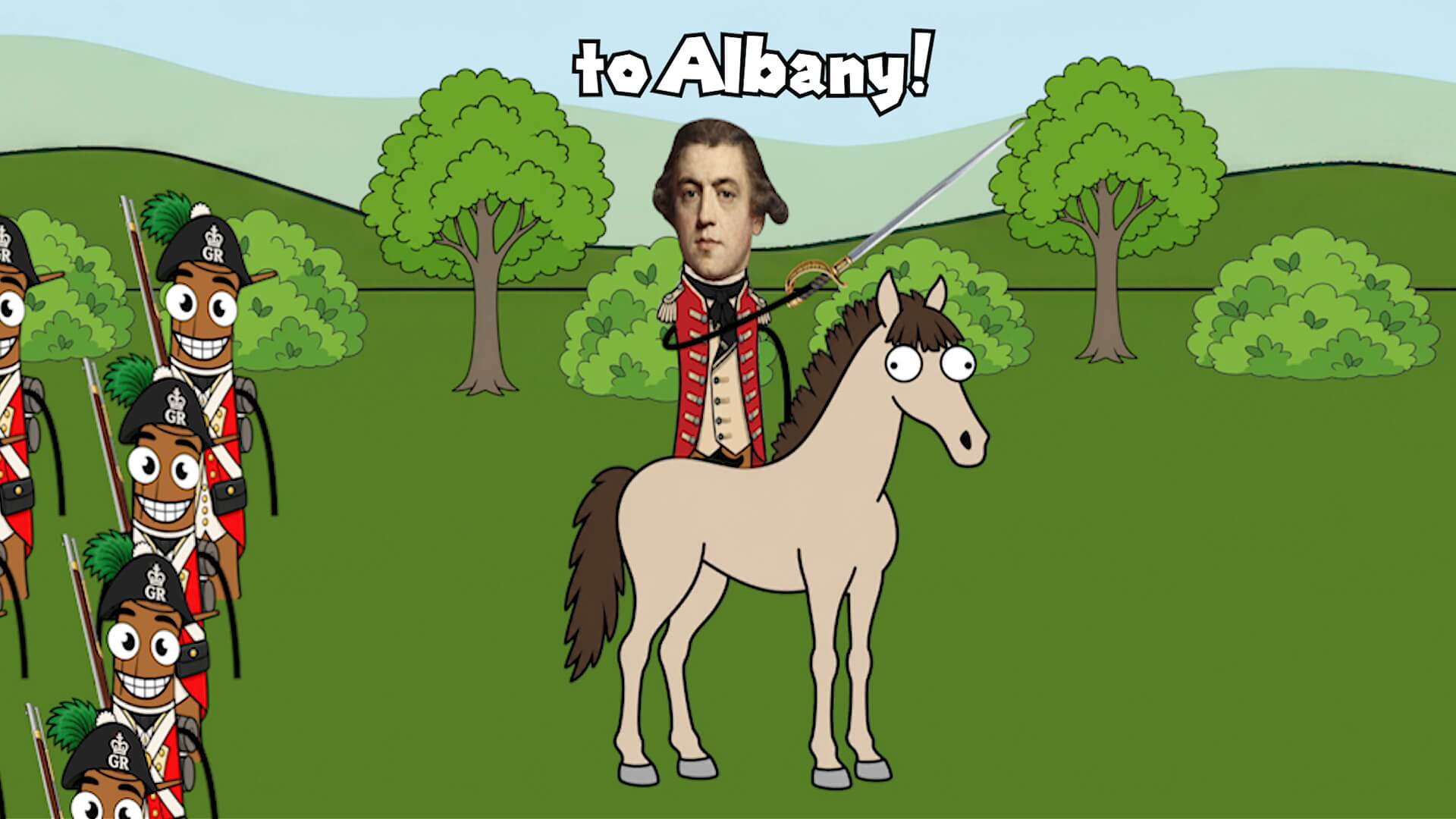
The Battles of Saratoga were two major battles fought during the American Revolutionary War in 1777. Taking place on September 19 and October 7, 1777, the battles played a crucial role in stopping a major British campaign and changing the direction of the war.
Fought near Saratoga, New York, the battles involved British forces commanded by General John Burgoyne and the American Continental Army led by General Horatio Gates.
Why Did the British Attack Saratoga?
British General John Burgoyne developed a plan to isolate New England from the other American colonies.
His army would advance south from Canada while other British forces moved north from New York City. If successful, the British hoped to divide the American colonies and weaken the rebellion.
At first, Burgoyne’s campaign appeared successful.
However, his army soon faced serious problems.
Supplies became difficult to obtain, the advance slowed, and American militia forces continued to grow.
The deeper Burgoyne moved into American territory, the more difficult it became to maintain his army.
The Battle of Freeman’s Farm
The first major battle took place on September 19, 1777, at Freeman’s Farm.
Burgoyne attempted to outflank the American forces defending the area around Bemis Heights.
However, American forces were prepared for the British advance.
Fighting quickly became intense.
The British eventually captured Freeman’s Farm, but they suffered heavy casualties in the process.
Although Burgoyne technically gained ground, the battle weakened his army and failed to achieve the decisive victory he needed.
The American forces, meanwhile, continued receiving reinforcements.
The British army was becoming increasingly isolated.
The Second Battle of Saratoga
For several weeks, both armies remained near their positions.
Burgoyne hoped that reinforcements would arrive from New York City.
But the situation became increasingly difficult.
On October 7, 1777, Burgoyne launched another attack near Bemis Heights.
This time, the American forces fought back aggressively.
American troops captured important British positions and forced Burgoyne’s army to retreat.
During the fighting, American forces under Benedict Arnold played an important role despite disagreements within the American command.
The British army could no longer maintain its position.
Burgoyne’s Surrender
After the defeat at Bemis Heights, Burgoyne withdrew toward Saratoga.
But his army was surrounded by a much larger American force.
With supplies running low and no immediate relief arriving, Burgoyne had few options left.
On October 17, 1777, General John Burgoyne surrendered his army to the Americans.
The surrender became one of the most important American victories of the Revolutionary War.
Why Were the Battles of Saratoga Important?
The Battles of Saratoga were a major turning point in the American Revolution.
The American victory demonstrated that the Continental Army could defeat a major British field army.
More importantly, the victory encouraged France to openly support the American cause.
France had already been providing weapons, ammunition, supplies, and military assistance to the Americans. After Saratoga, French support became more direct and eventually developed into a formal alliance.
French involvement brought soldiers, ships, money, and military resources into the conflict.
The war was no longer simply a rebellion between Britain and its American colonies.
It was becoming a much larger international conflict.
The Legacy of Saratoga
The Battles of Saratoga changed the strategic situation of the American Revolution.
Burgoyne’s failed campaign ended Britain’s attempt to isolate New England from the other American colonies.
The American victory also strengthened the Continental Army and encouraged foreign support for the revolutionary cause.
Years later, the war would eventually end with American independence.
But the road toward that victory was shaped by many battles.
Among them, Saratoga stands out as one of the most important turning points of the American Revolution.
The battlefield in New York had become more than just another military confrontation.
It was the place where a British army was stopped…
and where the American Revolution gained a powerful new ally.